Mawangdui
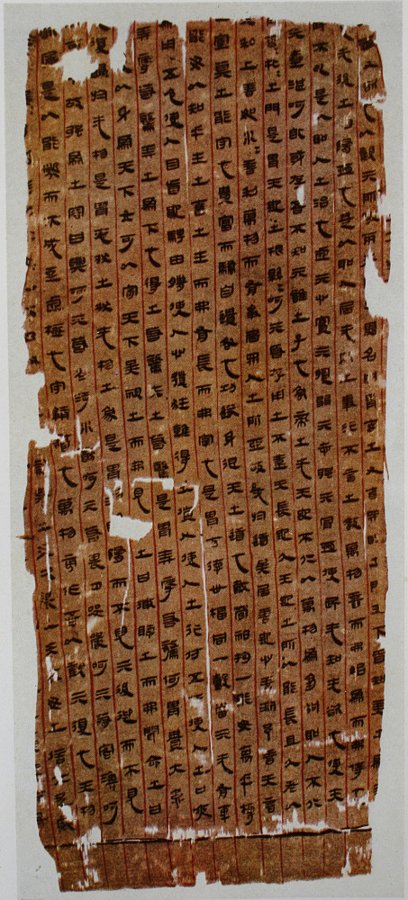
Шёлковая рукопись «Лаоцзы» из Мавандуя.
In 1973, excavations at Mawangdui (a suburb of Changsha, Hunan) opened Tomb No. 3 — the burial of a son of Li Cang, chancellor of Changsha, sealed in 168 BCE. Among its silk manuscripts were two copies of the Laozi: 甲本 (copy A) and 乙本 (copy B).
Copy A does not avoid the character 邦 — it was written before 202 BCE, before the naming taboo of Emperor Gaozu; copy B avoids 邦 but not 盈 — between 202 and 195 BCE. Both texts are arranged in reverse of the received order: the De jing precedes the Dao jing, while the chapter sequence is broadly close to the modern one. The Mawangdui find is the principal witness to the early form of the Daodejing and the baseline for comparing all later editions.
The complete corpus is published as 《长沙马王堆汉墓简帛集成》 (2014).