原文

马王堆老子甲

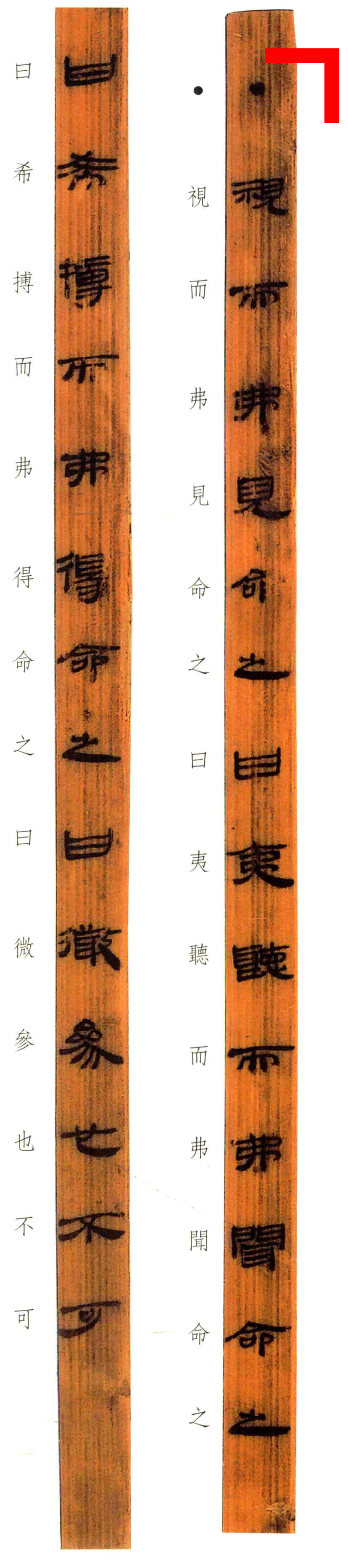
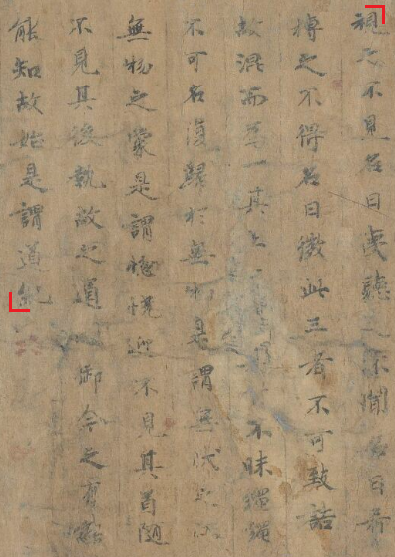
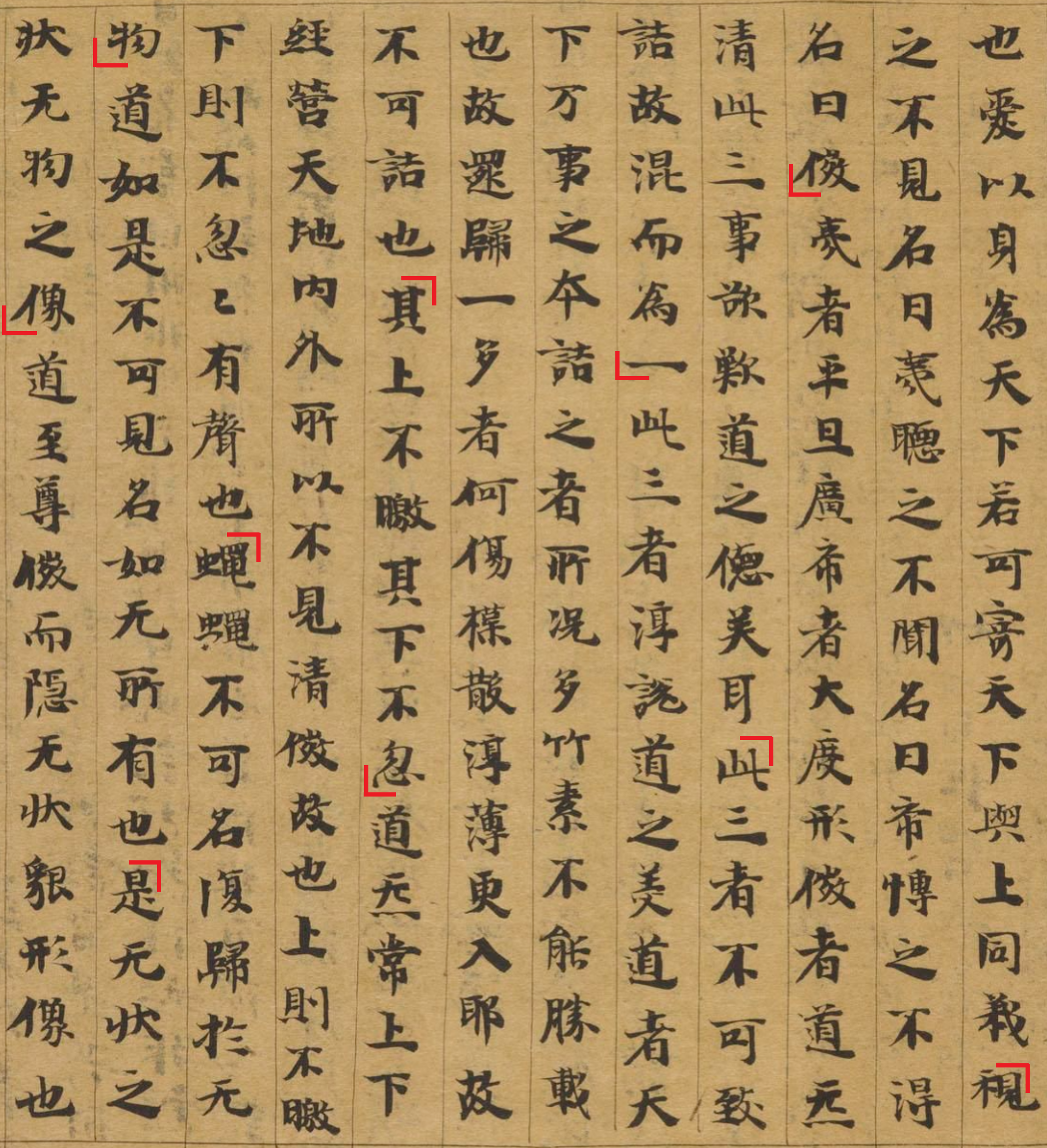
視之而弗見,名之曰微;聽之而弗聞,名之曰希;昏之而弗得,名之曰夷。三者不可至計,故混□□□一者,其上不收,其下不忽,尋尋呵不可名也,復歸於無物。是胃無狀之狀,無物之□□□□□□□□□□□□而不見其首。執今之道,以御今之有。以知古始,是胃□□。

马王堆老子乙

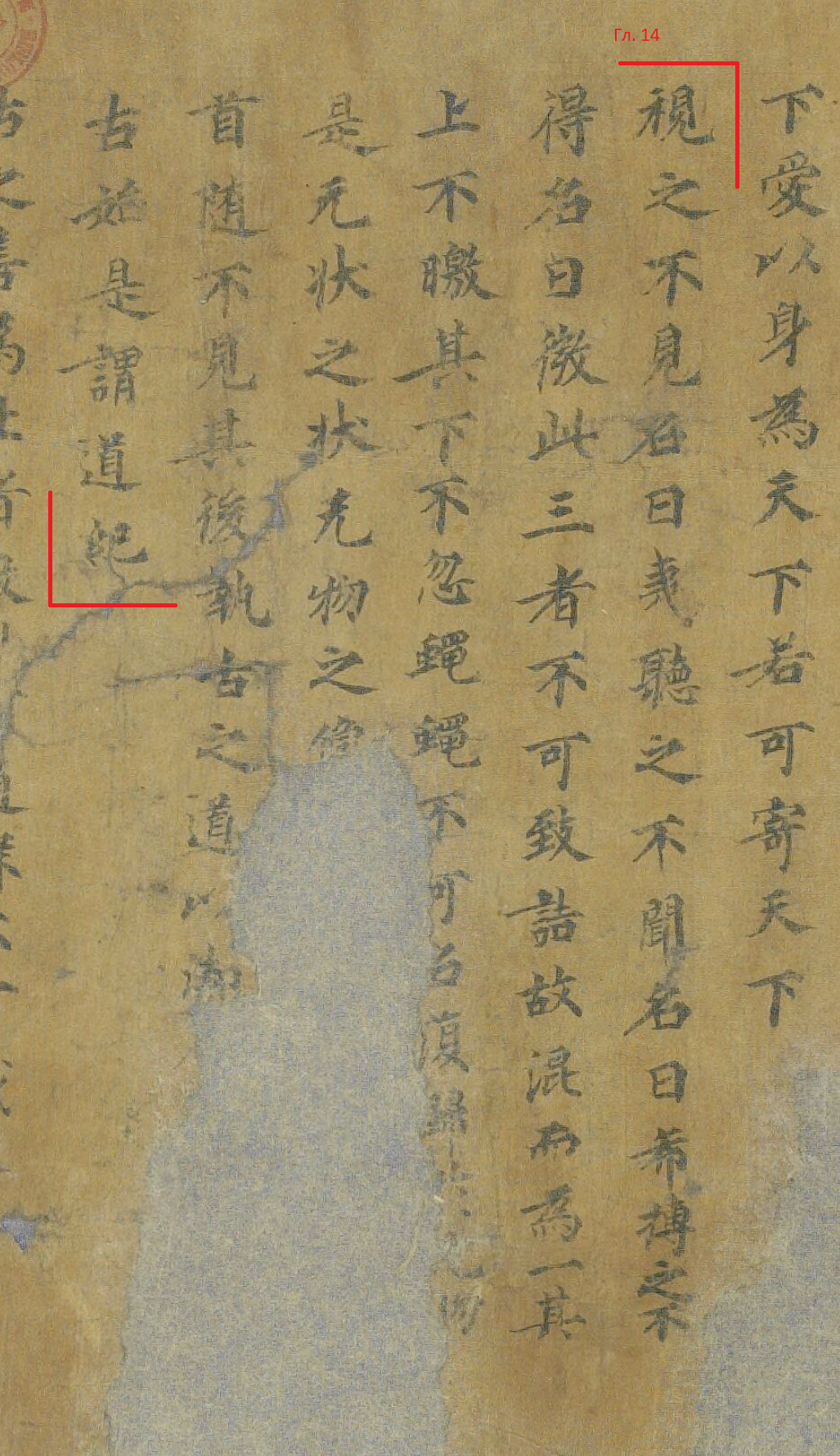
視之而弗見,□之曰微;聽之而弗聞,命之曰希;德昏之而弗得,命之曰夷。三者不可至計,故混而為一。一者其上不謬,其下不忽。尋尋呵不可命也,復歸於無物。是胃無狀之狀,無物之象,是胃忽望。隋而不見其後,迎而不見其首。執今之道,以御今之有。以知古始,是胃道紀。

王弼

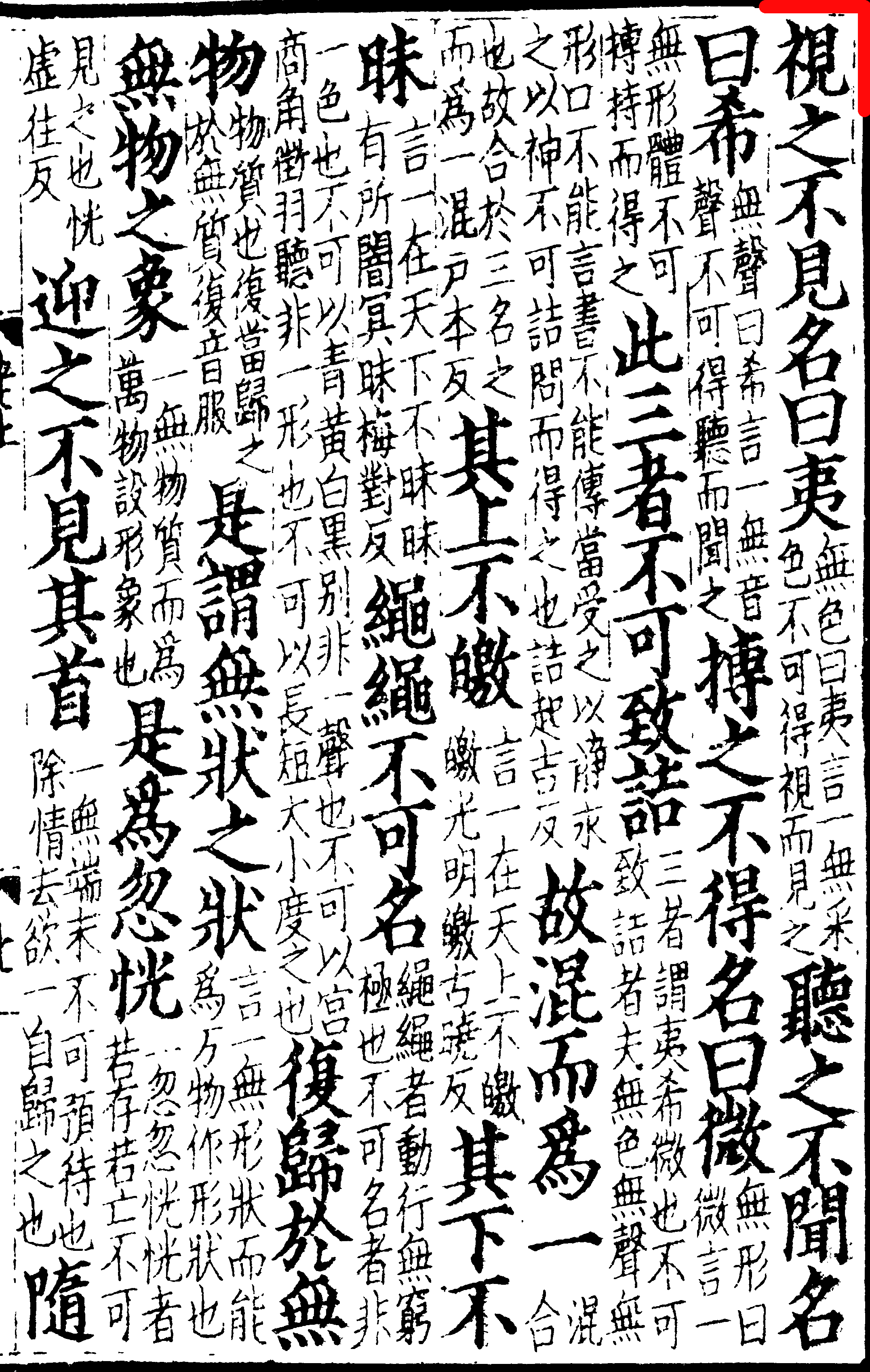
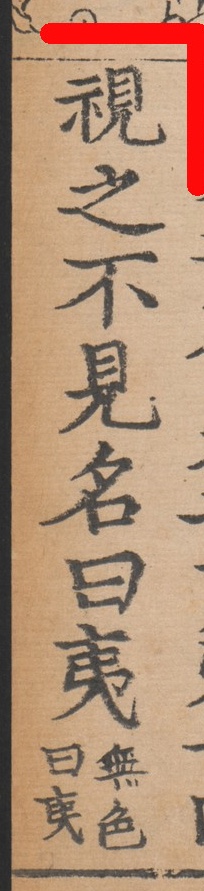
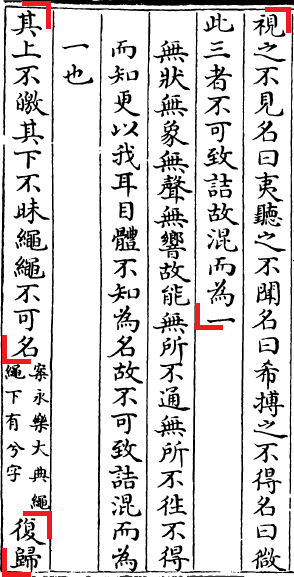
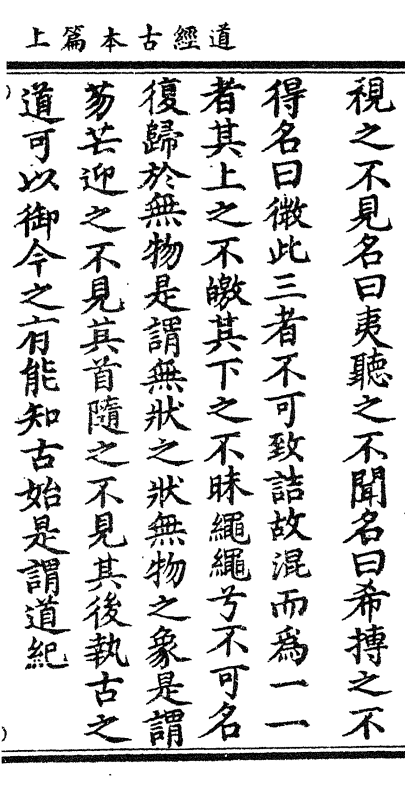
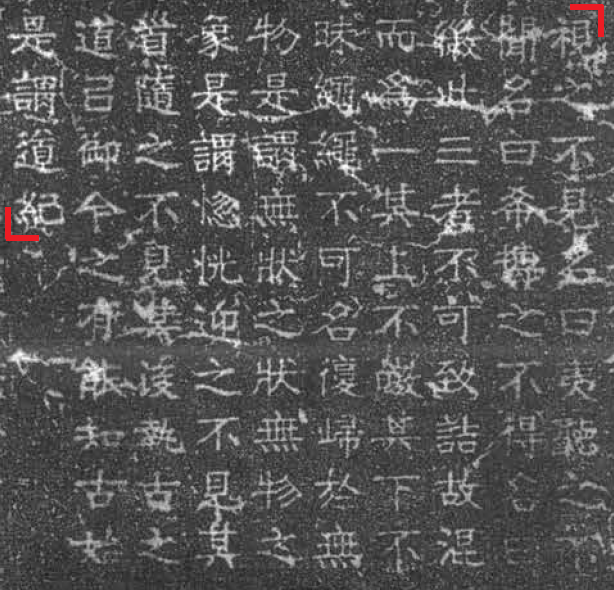
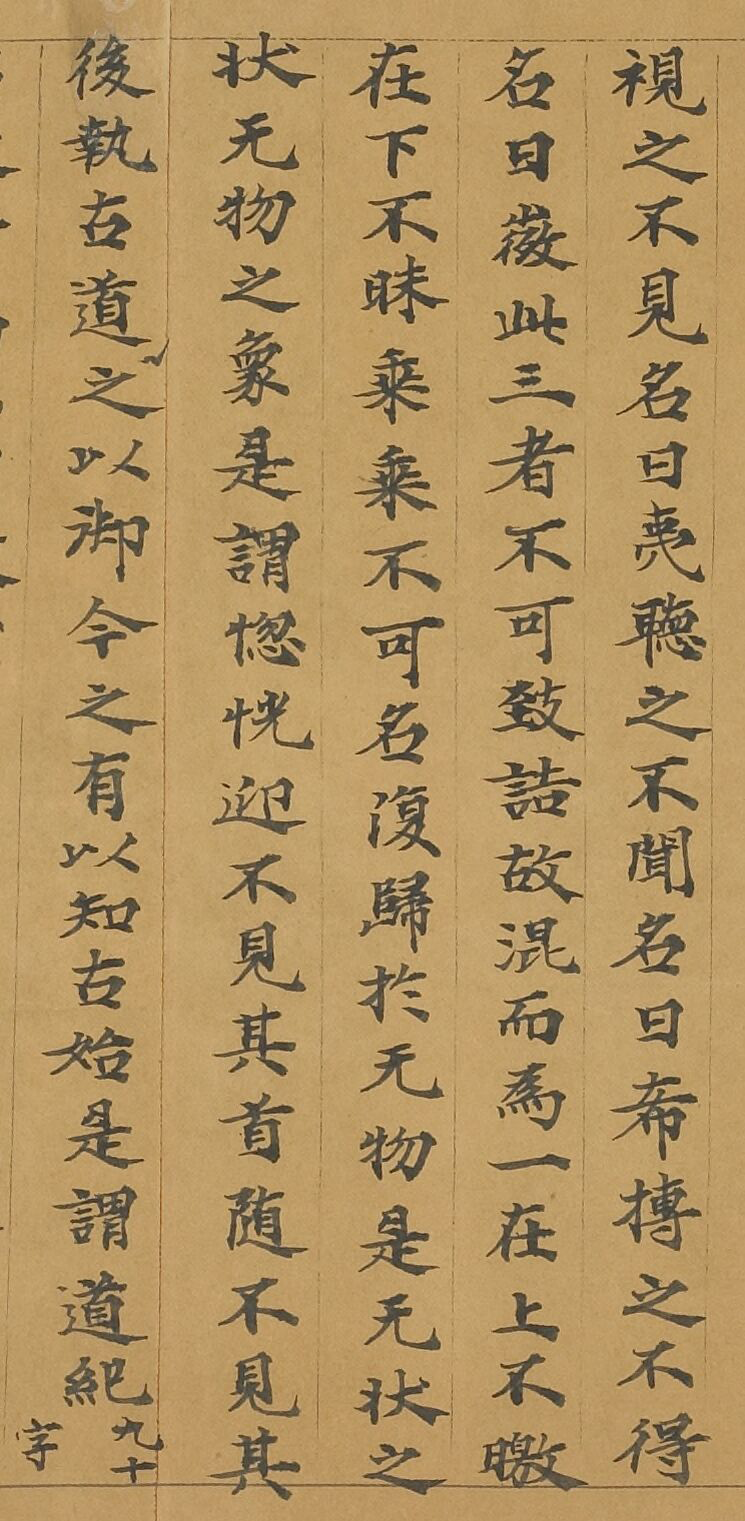
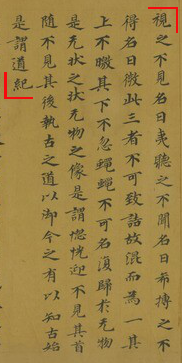
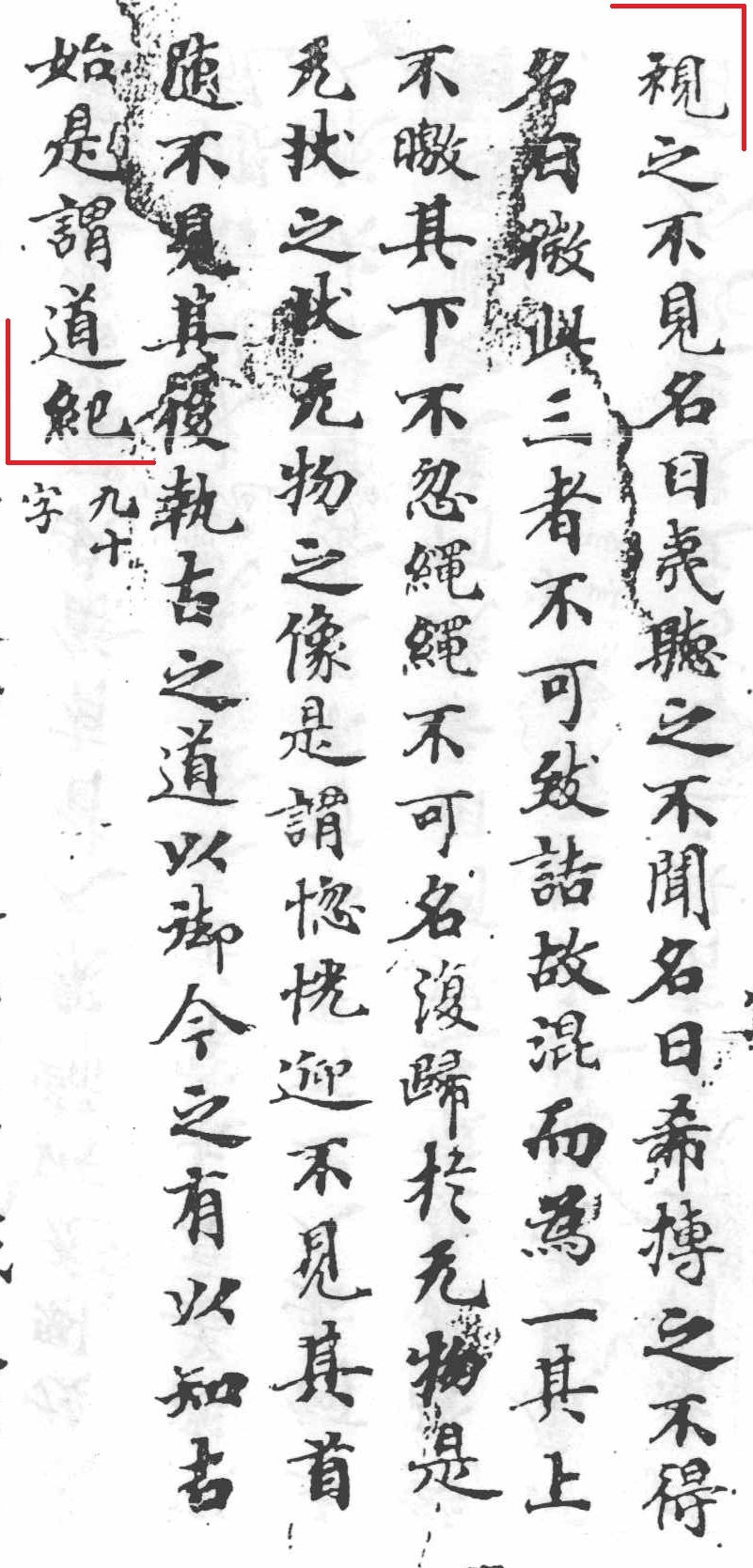
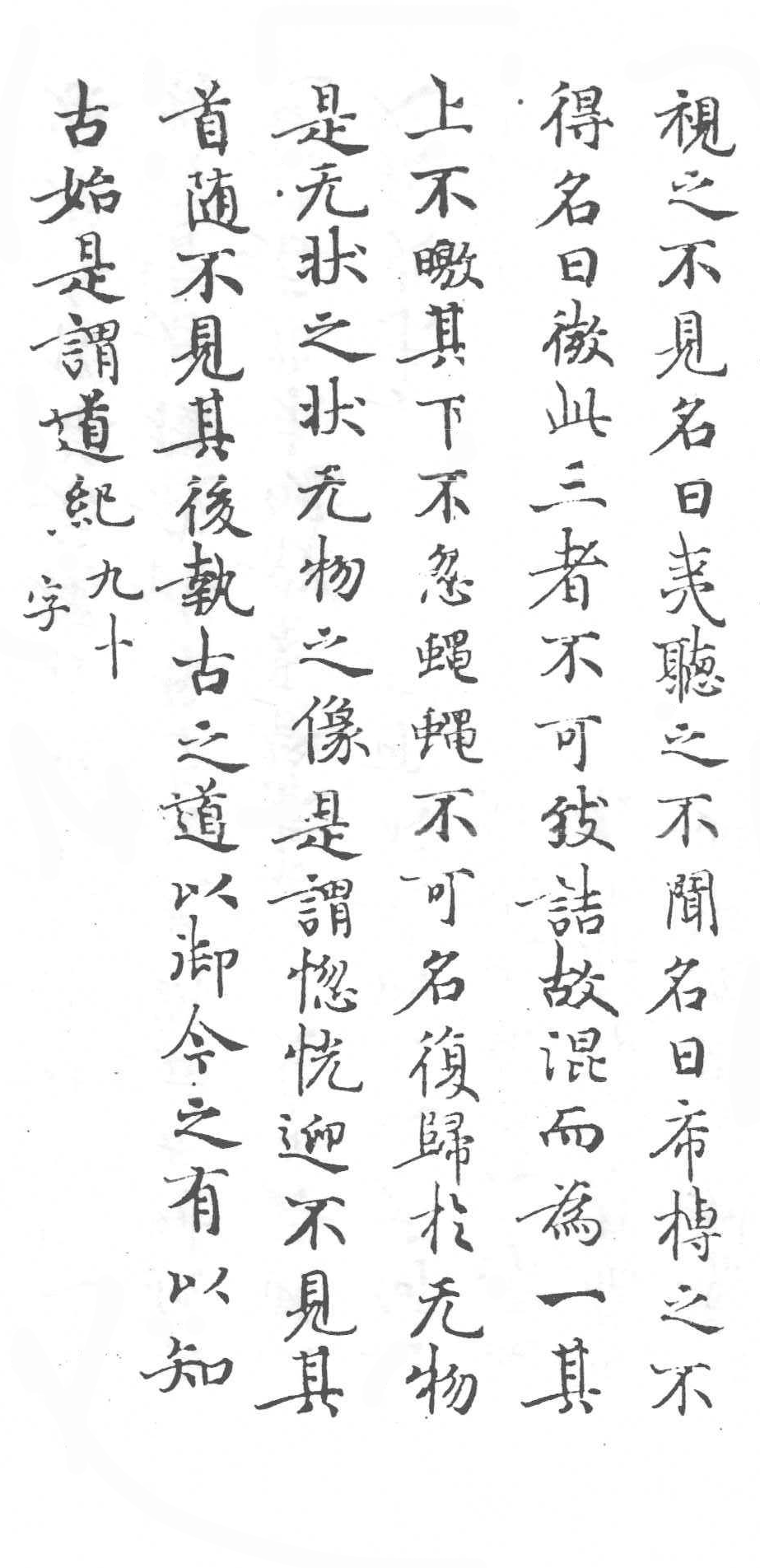
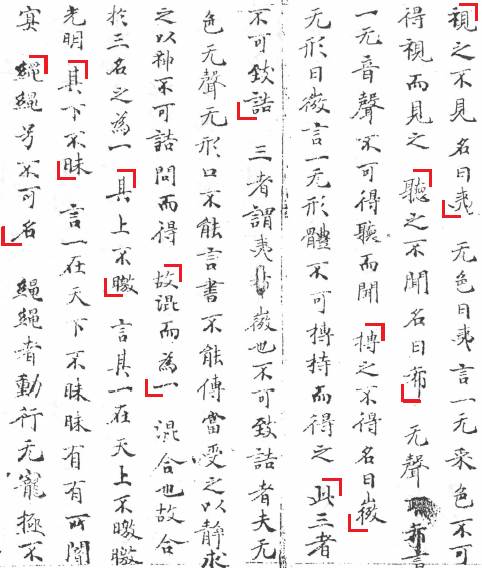
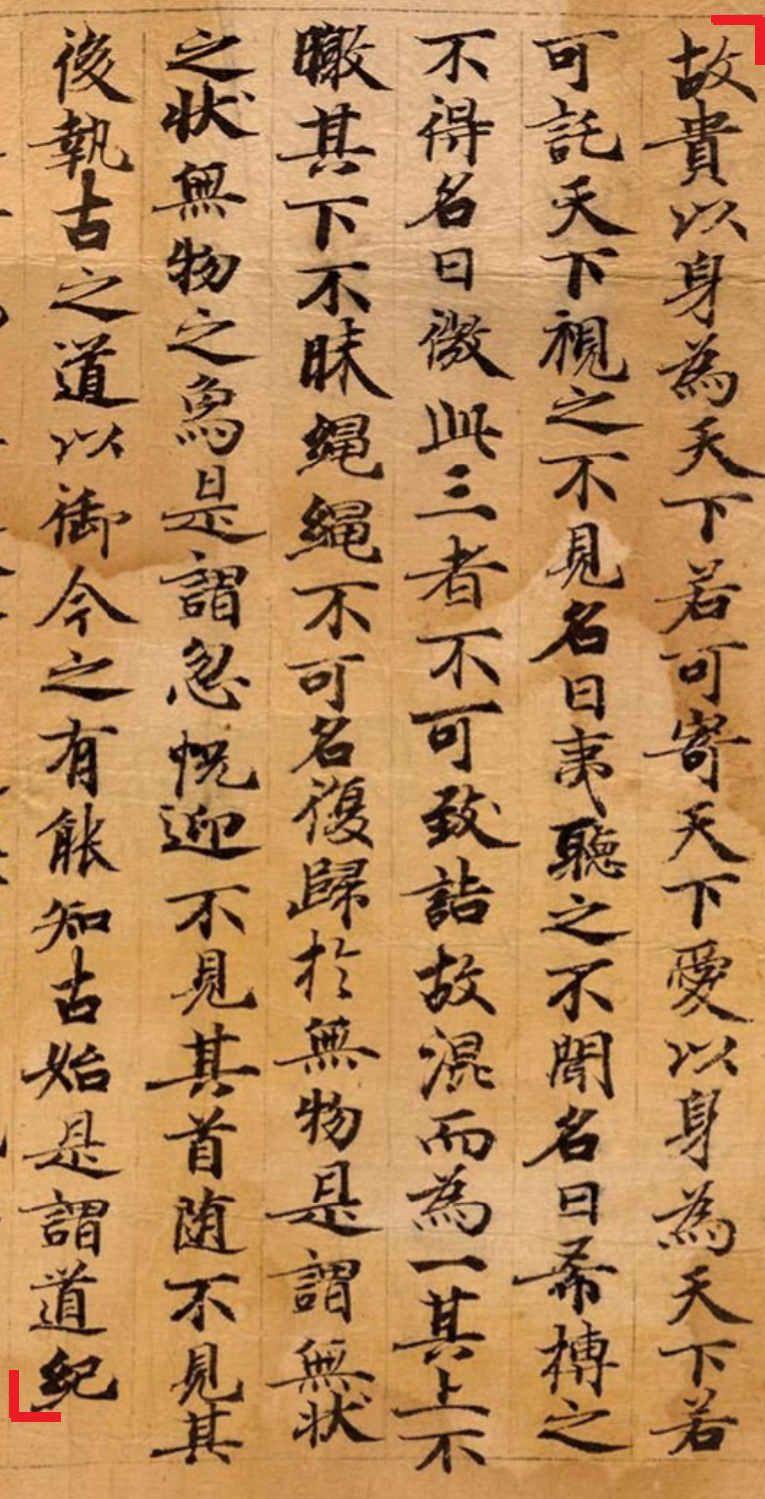
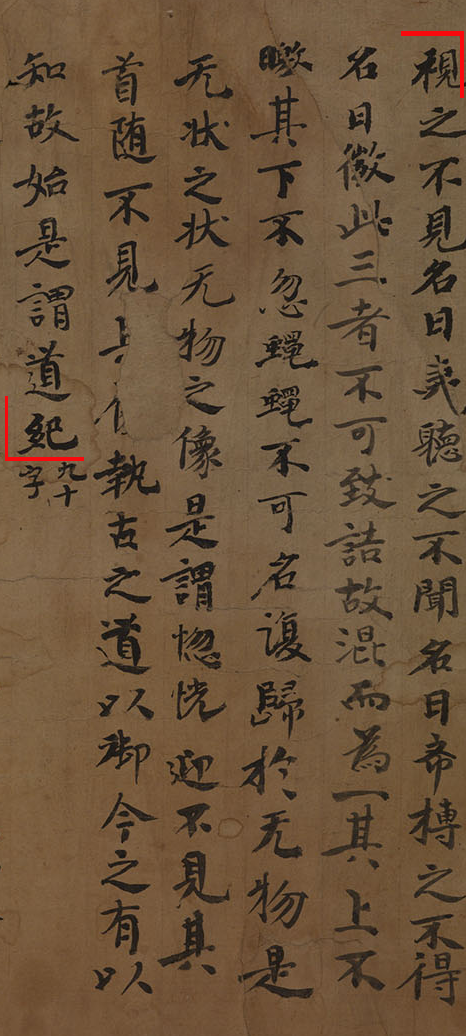
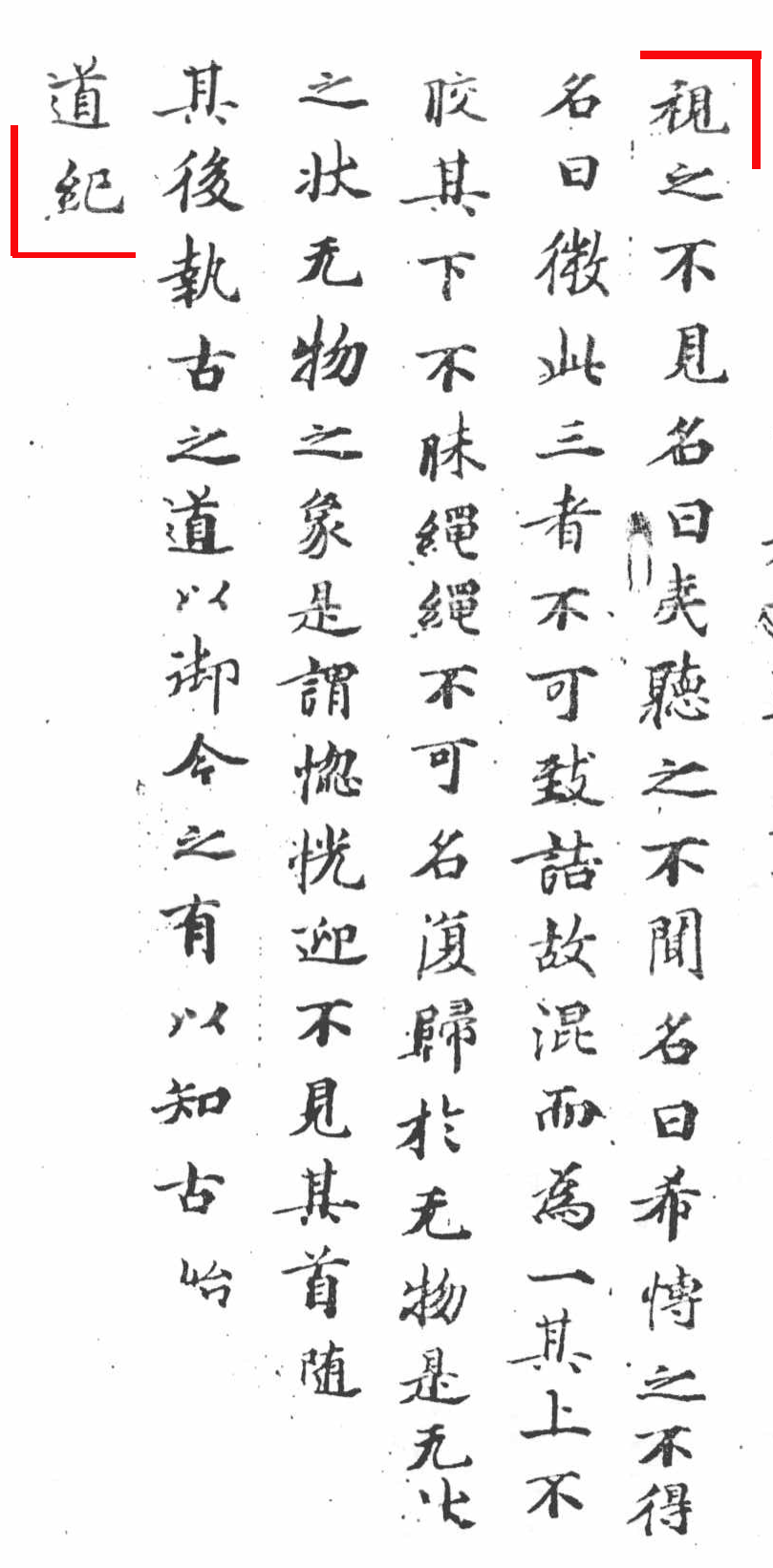
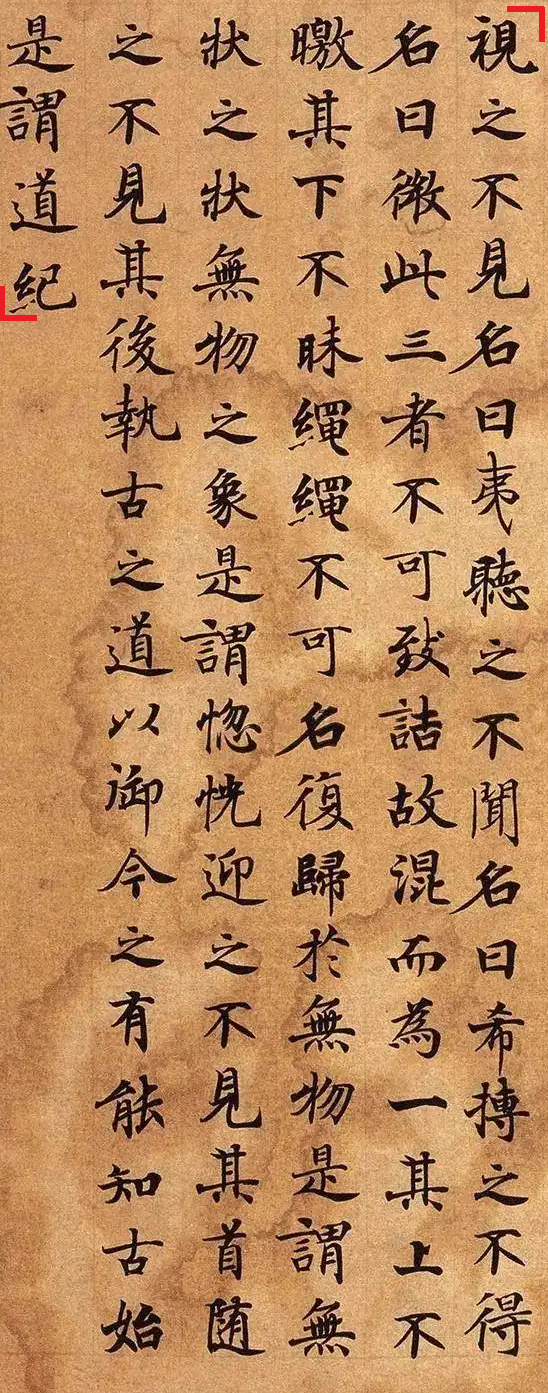
視之不見,名曰夷;聽之不聞,名曰希;搏之不得,名曰微。此三者不可致詰,故混而為一。其上不皦,其下不昧。繩繩不可名,復歸於無物。是謂無狀之狀,無物之象,是謂惚恍。迎之不見其首,隨之不見其後。執古之道,以御今之有。能知古始,是謂道紀。

译文

English

Paul Carus (1913)

PRAISING THE MYSTERIOUS.

1. We look at Reason and do not see it; its name is Colorless. We listen to Reason and do not hear it; its name is Soundless. We grope for Reason and do not grasp it; its name is Bodiless. 2. These three things cannot further be analyzed. Thus they are combined and conceived as a unity which on its surface is not clear and in its depth not obscure. 3. Forever and aye Reason remains unnamable, and again and again it returns home to non-existence. 4. This is called the form of the formless, the image of the imageless. This is called the transcendentally abstruse. 5. In front its beginning is not seen. In the rear its end is not seen. 6. By holding fast to the Reason of the ancients, the present is mastered and the origin of the past understood. This is called Reason's clue.

John Chalmers (1868)

The praise of the Abyss

What you cannot see by looking at it, is called plainness. What you cannot hear by listening to it, is called rareness. What you cannot get by grasping it, is called minuteness. These three cannot be examined, and therefore they blend into Unity. Above it is not bright, below it is not obscure. Boundless in its operation, it cannot be named. Returning, it goes home into nothing. This I call the appearance of non-appearance, the form of nothing. This is what baffles investigation. Would you go before it, you cannot see its face. Would you go behind it, you cannot see its back. But to have such an apprehension of the Tau which was from of old as to regulate present things, and to know their beginning in the past; this I call having the clue of Tau.

James Legge (1891)

The Manifestation of the Mystery

We look at it, and we do not see it, and we name it 'the Equable.' We listen to it, and we do not hear it, and we name it 'the Inaudible.' We try to grasp it, and do not get hold of it, and we name it 'the Subtle.' With these three qualities, it cannot be made the subject of description; and hence we blend them together and obtain The One. Its upper part is not bright, and its lower part is not obscure. Ceaseless in its action, it yet cannot be named, and then it again returns and becomes nothing. This is called the Form of the Formless, and the Semblance of the Invisible; this is called the Fleeting and Indeterminable. We meet it and do not see its Front; we follow it, and do not see its Back. When we can lay hold of the Tao of old to direct the things of the present day, and are able to know it as it was of old in the beginning, this is called (unwinding) the clue of Tao.
Русский

Д.П. Кониси (1894)

Предмет, на который мы смотрим, но не видим, называется бесцветным. (Звук, который) мы слушаем, но не слышим — беззвучным. (Предмет, который) мы хватаем, но не можем захватить — мельчайшим. Эти три (предмета) неисследимы, поэтому когда они смешаются между собой, то соединяются в одно. Верх не ясен, низ не темен. О, бесконечное! Его нельзя назвать именем. Оно существует, но возвращается к небытию. Оно называется формою (или видом) бесформенною. Оно также называется неопределенным. Встречаясь с ним, не видать лица его, следуя же за ним, не видать спины его. Посредством древнего Тао можно управлять жизнью настоящего времени. Исследовать происхождение всего (или начало древности) называется нитью Тао.

Архим. Даниил (Сивиллов) (1828)

Понятие о существе Божием.

Что весьма ровно или плоско, того нельзя видеть, хотя бы мы на то и смотрели; а что весьма редко, того нельзя слышать, хотя бы то мы и слушали; а что весьма тонко, того нельзя уловить, хотя бы мы и желали то поймать. В чем же состоит существо сих трех предметов, о том не нужно слишком много теперь распространяться. Из состава сих трех предметов произошло одно. Наверху сего состава неприметного света, а снизу не видно мрака. В средине сего состава находится некто, который от века существует беспрестанно. Его нельзя назвать никаким именем. Когда Он входит в свое самобытное существо, и делается невидимым, тогда ни вида его нельзя описать, ни образа представить, и Он кажется тогда, как будто бы не существует, и в тоже время, однако ж, существовать не престает. Если станем идти прямо против Него, то перед у Него становится невидимым; а если вслед за Ним захочешь идти, то зад его нельзя усмотреть. Кто сохраняет постановления древних, необходимые для управления делами человеческими, тот только может знать древнее начало, которое положено в основание сему закону.
Français

Stanislas Julien (1842)

Vous le regardez (le Tao) et vous ne le voyez pas : on le dit incolore. Vous l’écoutez et vous ne l’entendez pas : on le dit aphone. Vous voulez le toucher et vous ne l’atteignez pas : on le dit incorporel. Ces trois qualités ne peuvent être scrutées à l’aide de la parole. C’est pourquoi on les confond en une seule. Sa partie supérieure n’est point éclairée ; sa partie inférieure n’est point obscure. Il est éternel et ne peut être nommé. Il rentre dans le non-être. On l’appelle une forme sans forme, une image sans image. On l’appelle vague, indéterminé. Si vous allez au-devant de lui, vous ne voyez point sa face ; si vous le suivez, vous ne voyez point son dos. C’est en observant le Tao des temps anciens qu’on peut gouverner les existences d’aujourd’hui. Si l’homme peut connaître l’origine des choses anciennes, on dit qu’il tient le fil du Tao.

Léon Wieger (1913)

A. En regardant, on ne le voit pas, car il est non-visible. En écoutant, on ne l’entend pas, car il est non-sonore. En touchant, on ne le sent pas, car il est non-palpable. Ces trois attributs ne doivent pas être distingués, car ils désignent un même être. B. Cet être, le Principe, n’est pas lumineux en dessus et obscur en dessous, comme les corps matériels opaques, tant il est ténu. Il se dévide (existence et action continues). Il n’a pas de nom propre. Il remonte jusqu’au temps où il n’y eut pas d’êtres autres que lui. Superlativement dépourvu de forme et de figure, il est indéterminé. Il n’a pas de parties ; par devant on ne lui voit pas de tête, par derrière pas d’arrière-train. C. C’est ce Principe primordial, qui régit tous les êtres, jusqu’aux actuels. Tout ce qui est, depuis l’antique origine, c’est le dévidage du Principe.
Deutsch

Reinhold von Plaenckner (1870)

Wenn du zu ihm aufschauest, so siehst du es nicht, denn es ist unsichtbar. Wenn du ihm lauschen willst, so hörst du es nicht, denn es ist lautlos. Wenn du nach ihm fassest, so kannst du es nicht ergreifen, denn es ist unkörperlich, daher unbegreiflich. Diese drei Eigenschaften, die sich nicht näher definiren lassen, kennzeichnen vereint das Wesen des Einen — des Táo. Es kann keine Licht-, keine Schattenseite haben, es ist ewig und unvergänglich, und es ist nicht möglich, ein bezeichnendes Bild, einen Namen dafür zu finden. Wir kommen immer darauf zurück, dass es nur als ein übersinnliches, durchaus immaterielles Wesen gedacht werden kann; denn Wie könnte man das formen wollen, was keine Form hat, das darstellen wollen, was gestaltlos ist? Es ist das vollendet Geistige! Trittst du ihm entgegen, so siehst du sein Gesicht nicht, trittst du ihm nach, so siehst du seinen Rücken nicht! — Wenn man das Táo aber sich so vorstellt, wie es die Alten sich dachten, und wie die Idee auf die Neuzeit sich heranbildete, und so an der Hand der Geschichte und der Erfahrung das Táo von der ersten Idee darüber erfasst, so nennt man dies die Empirie der Táo-Idee.

Victor von Strauß (1870)

Man schaut Ihn ohne zu sehen: sein Name heisst I (Gleich); man vernimmt Ihn ohne zu hören: sein Name heisst Hi (Wenig); man fasst Ihn ohne zu bekommen: sein Name heisst Wi (Fein). Diese Drei können nicht ausgeforscht werden; drum werden sie verbunden und sind Einer. Sein Oberes ist nicht klar, sein Unteres nicht dunkel. Je und je ist er unnennbar und wendet sich zurück ins Nicht-Wesen. Das heisst des Gestaltlosen Gestalt, des Bildlosen Bild; das ist gar unerfasslich. Ihm entgegnend siehet man nicht sein Haupt, ihm nachfolgend siehet man nicht seine Rückseite. Hält man sich an den Tao des Alterthums, um zu beherrschen das Seyn der Gegenwart, so kann man erkennen des Alterthums Anfänge: das heisst Tao's Gewebaufzug.

Richard Wilhelm (1911)

Lob des Geheimnisses

Man schaut nach ihm und sieht ihn nicht: Sein Name ist: Gleich. Man horcht nach ihm und hört ihn nicht: Sein Name ist: Fein. Man faßt nach ihm und ergreift ihn nicht: Sein Name ist: Klein. Diese drei kann man nicht trennen, Sie sind vermischt und bilden Eines. Sein Oberes ist nicht klarer, sein Unteres ist nicht trüber. Grenzenlos quellend, man kann ihn nicht nennen, er reicht zurück ins Nicht-Wesen. Das ist es, das gestaltlose Gestalt heißt, und das bildloses Bild heißt. Das ist es, das Unsichtbarkeit heißt: Ihm entgegenkommend sieht man nicht sein Antlitz, ihm folgend sieht man nicht seine Rückseite. Wer erfaßt den SINN des Alten, kann damit beherrschen das Sein des Heute und kann die Uranfänge erkennen: Das ist des SINNS durchgehender Faden.

可用来源