Originaltexte

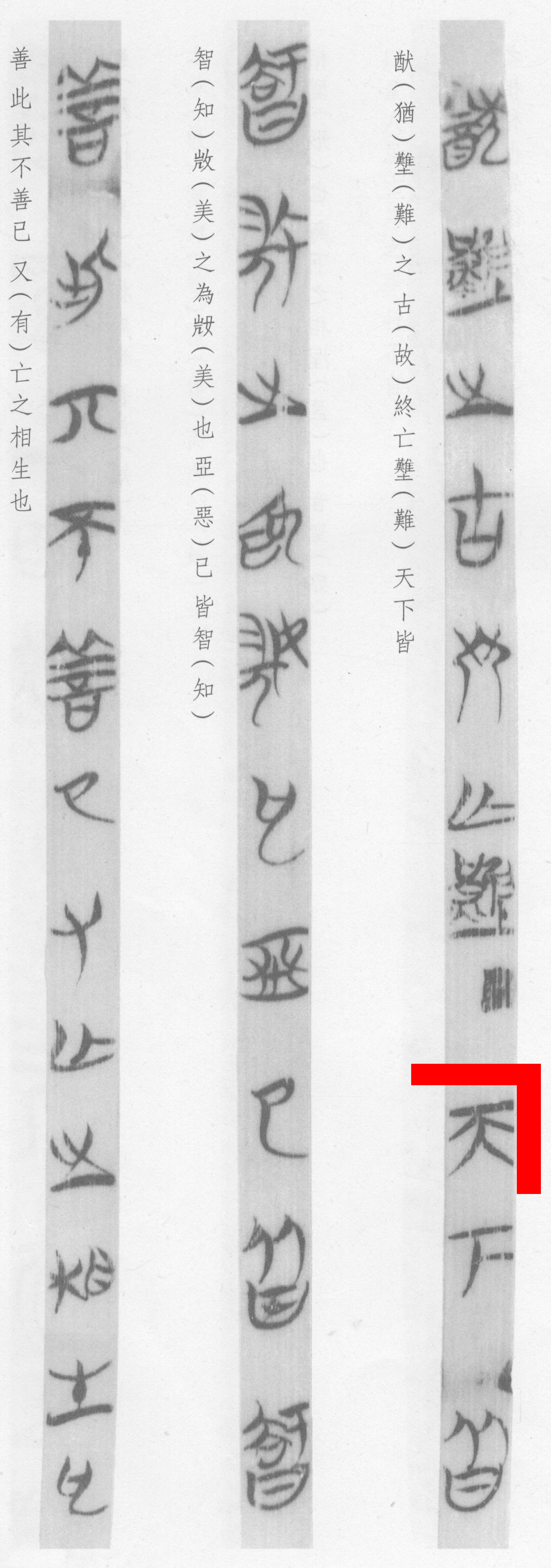
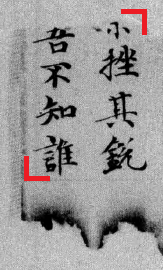
Guodian Laozi A

天下皆知美之為美也,惡已;皆知善,此斯不善已。有亡之相生也,難易之相成也,長短之相形也,高下之相呈也,音聲之相和也,先後之相隨也。是以聖人居亡為之事,行不言之教。萬物作而弗治也,為而弗志也,成而弗居。夫唯弗居也,是以弗去也。

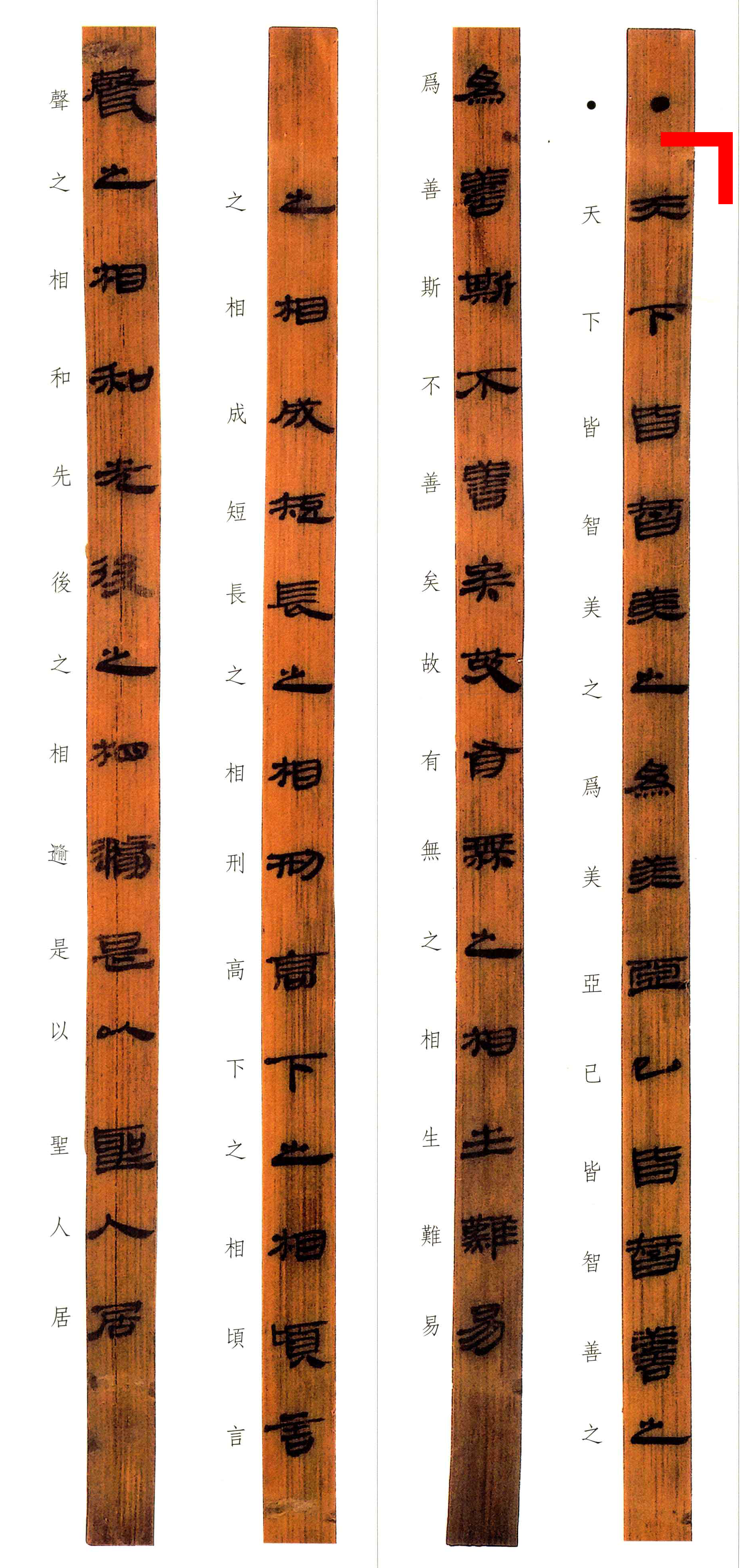
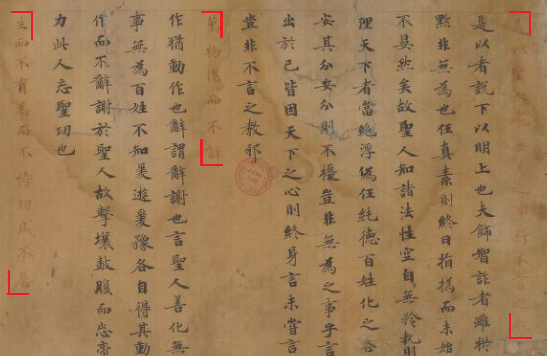
Mawangdui Laozi A

天下皆知美為美,惡已。皆知善,斯不善矣。有無之相生也,難易之相成也,長短之相刑也,高下之相盈也,意聲之相和也,先後之相隋恆也。是以聲人居無為之事,行□□□□□□□□□□也,為而弗志也,成功而弗居也。夫唯居,是以弗去。

Mawangdui Laozi B

天下皆知美之為美,亞已。皆知善,斯不善矣。□□□□生也,難易之相成也,長短之相刑也,高下之相盈也,音聲之相和也,先後之相隋恆也。是以聖人居無為之事,行不言之教;萬物昔而弗始,為而弗侍也,成功而弗居也,夫唯弗居,是以弗去。

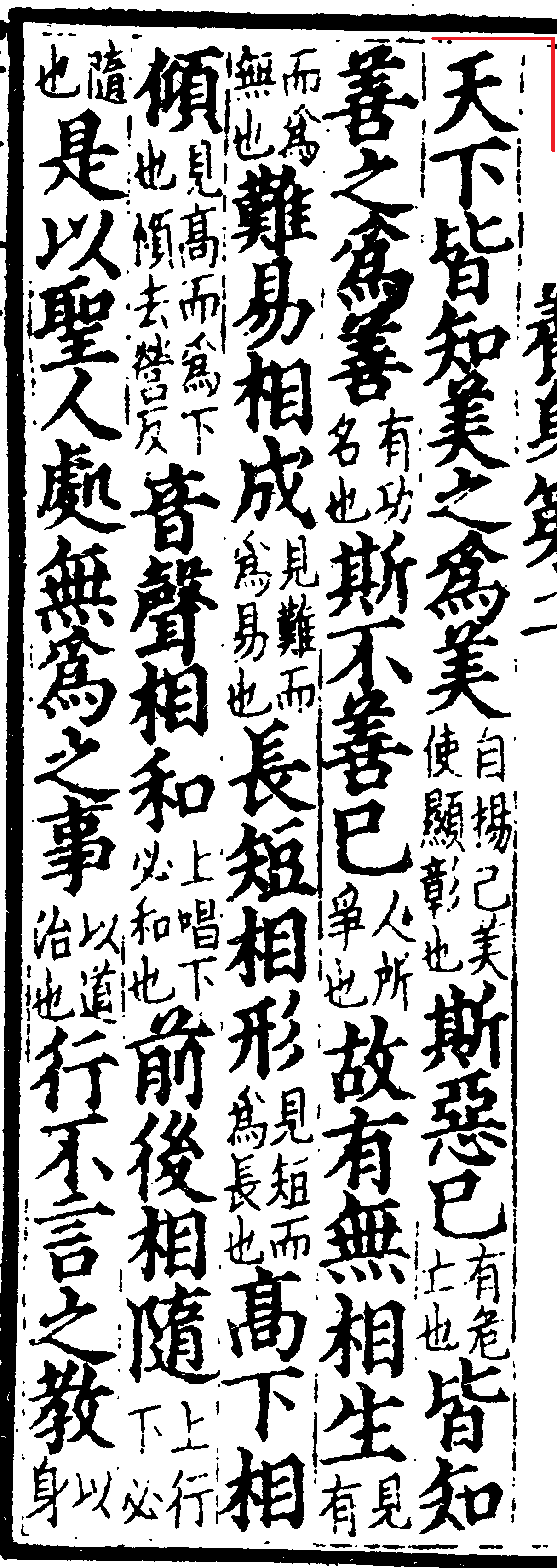
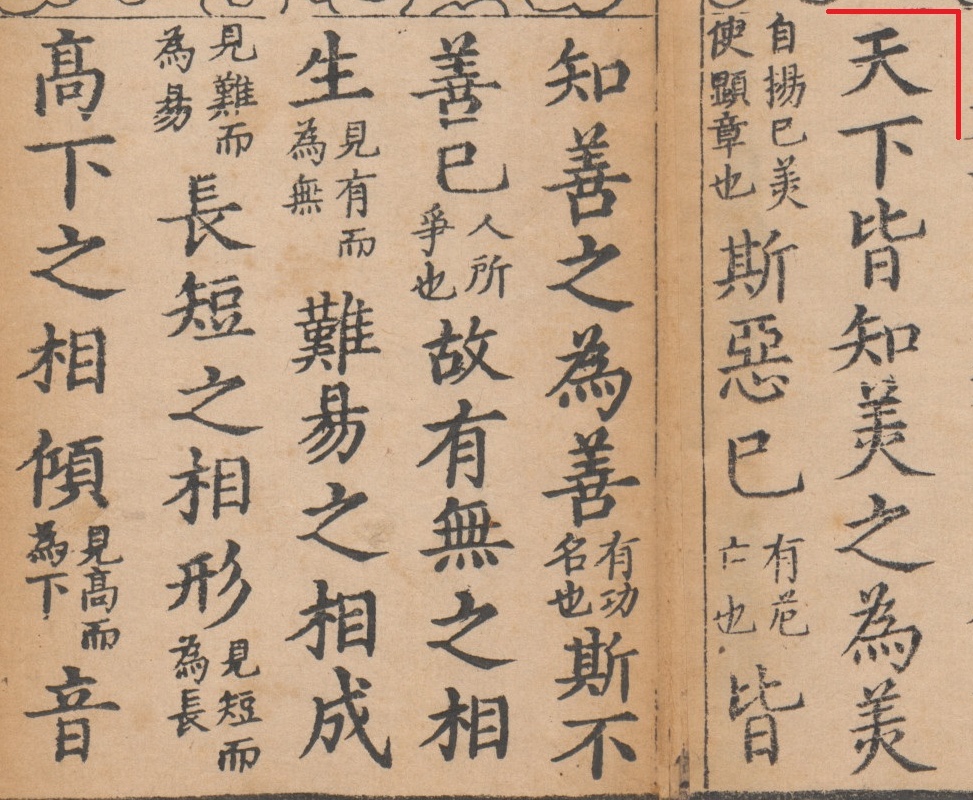
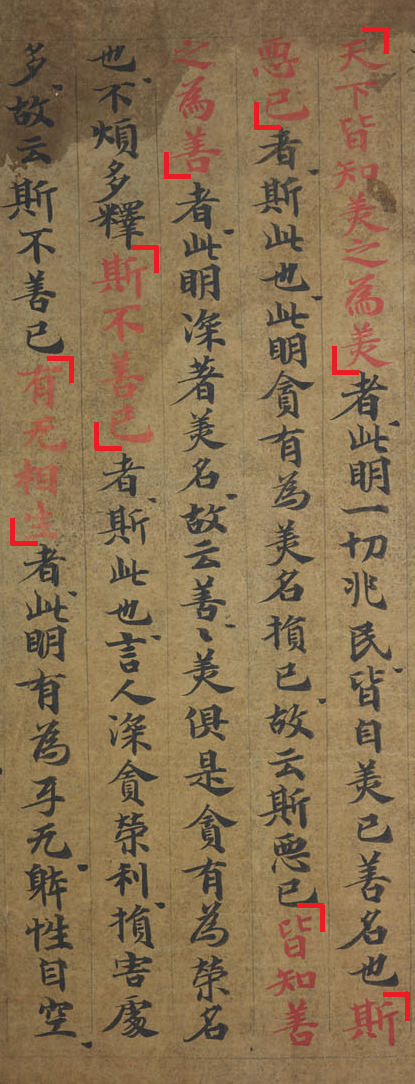
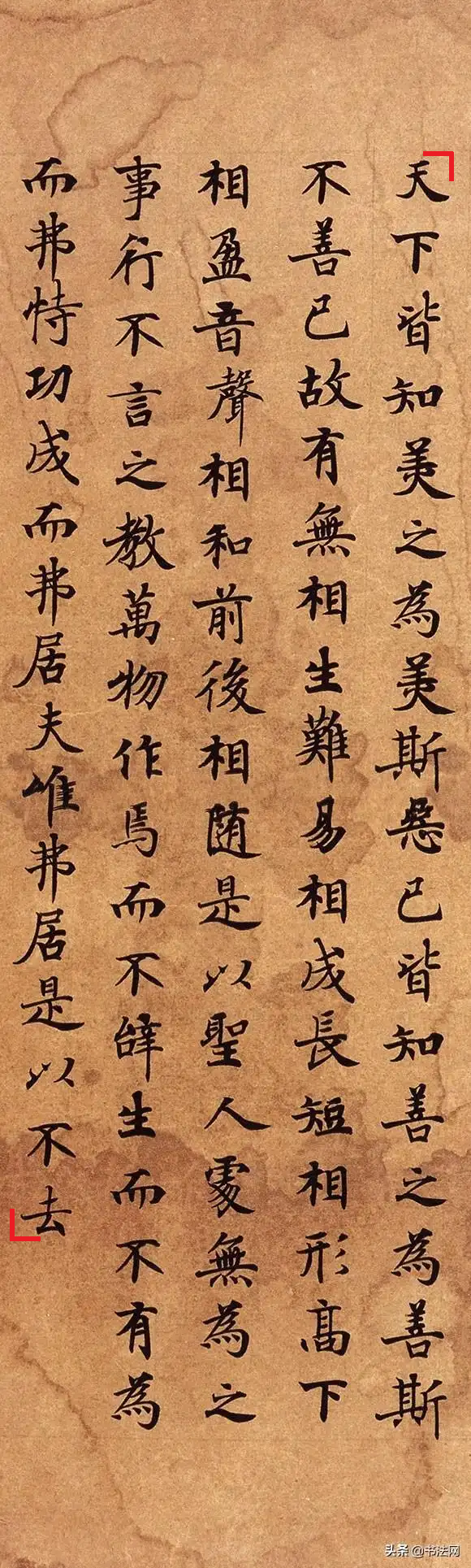
Wang Bi

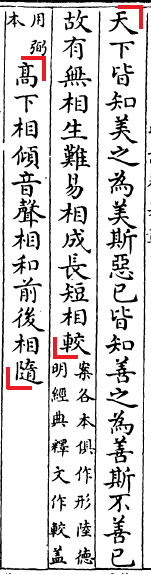
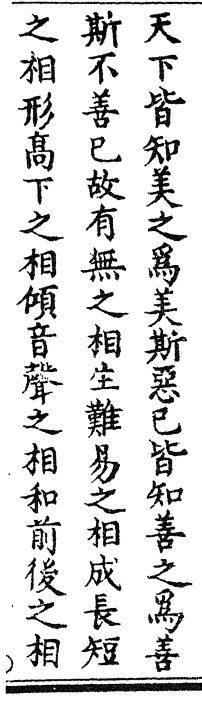
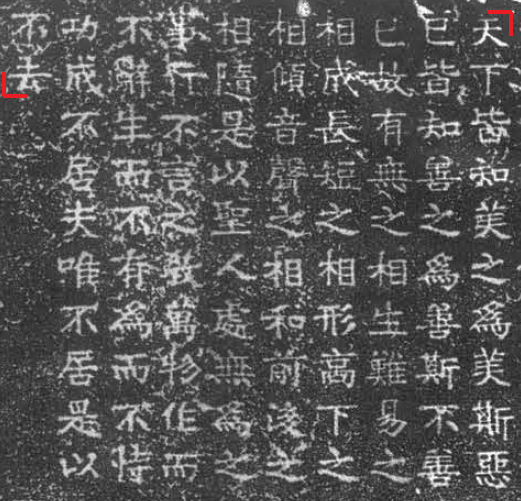
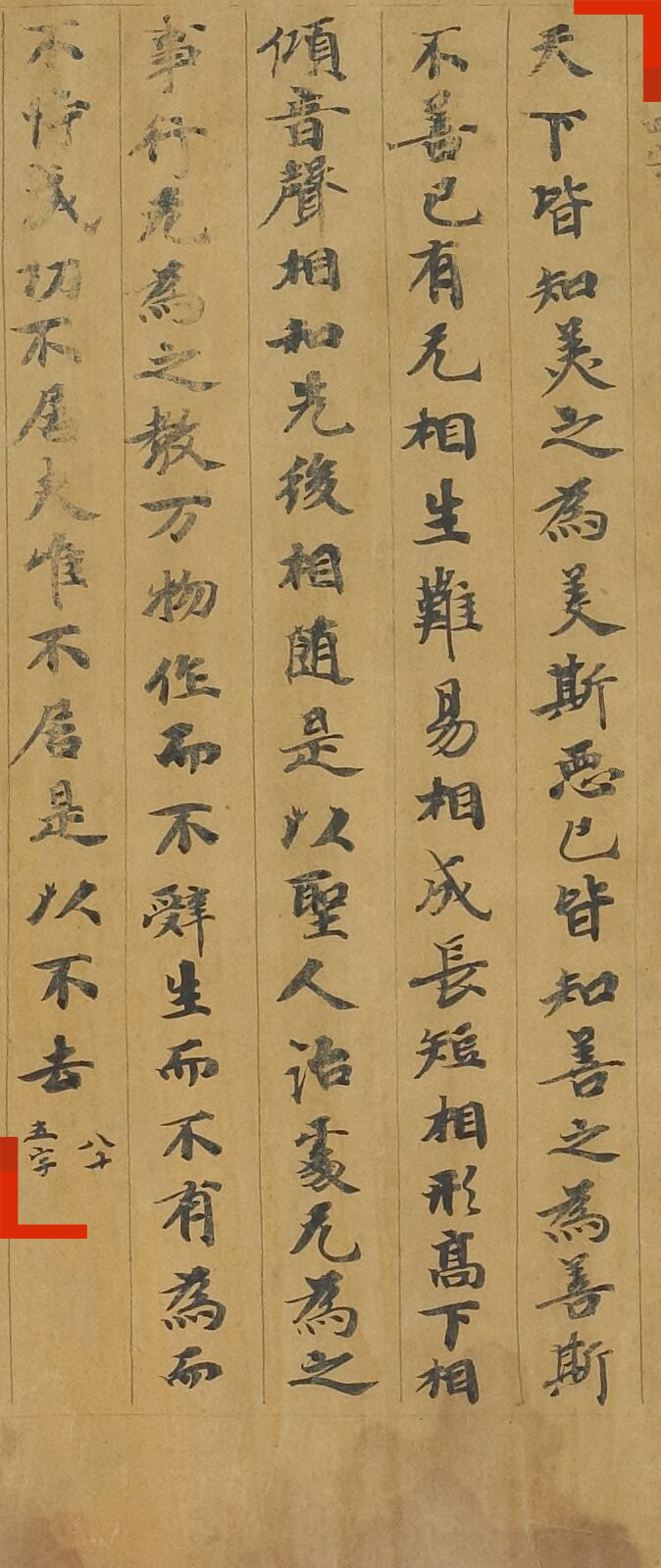
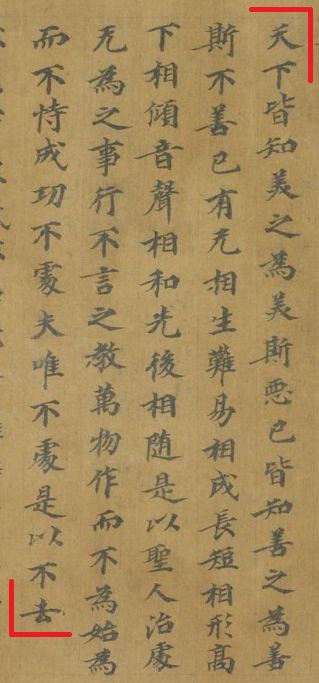
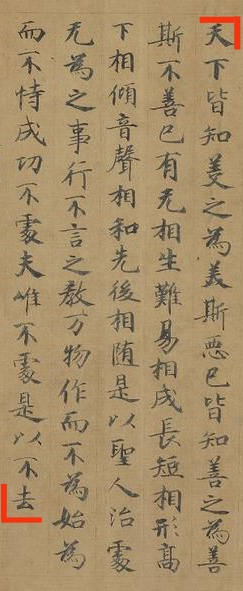
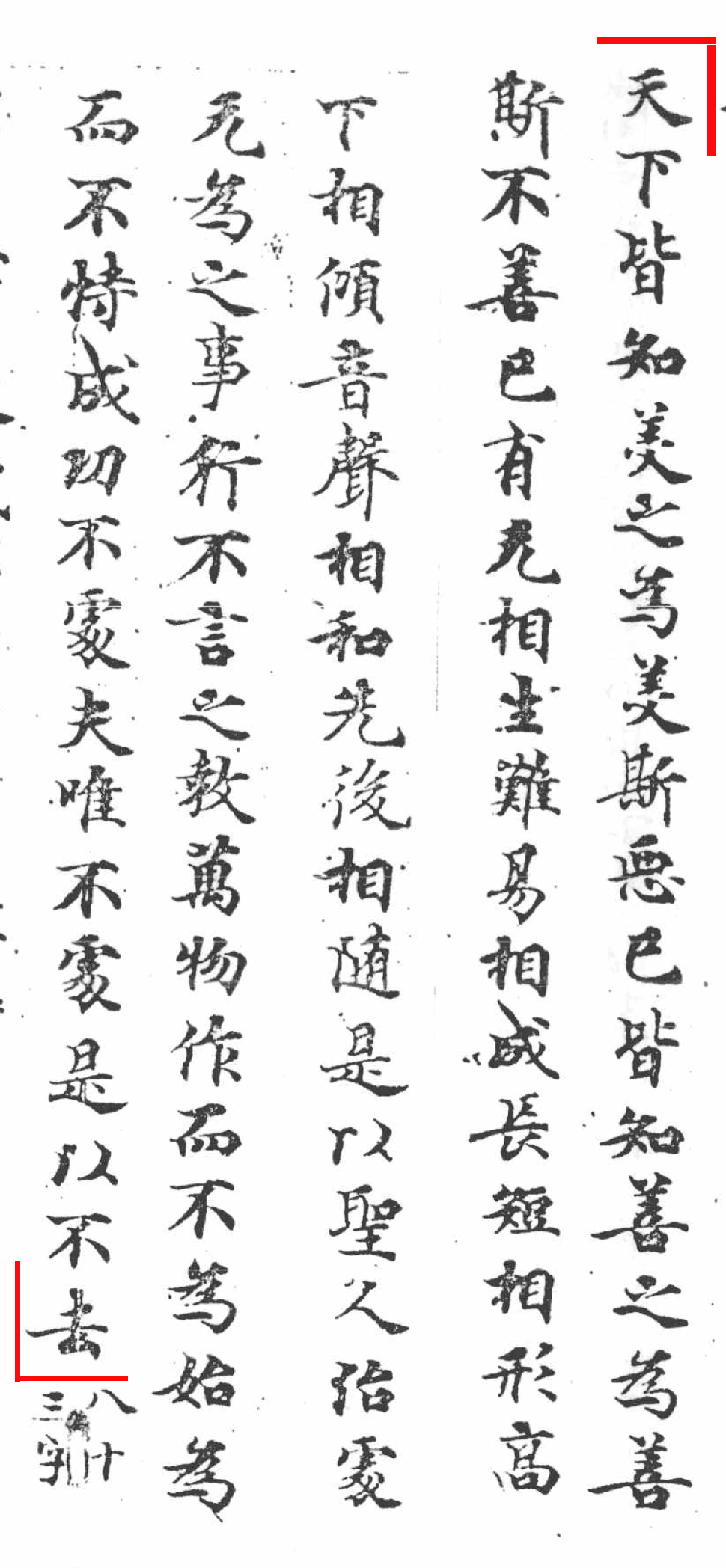
天下皆知美之為美,斯惡已。皆知善之為善,斯不善已。故有無相生,難易相成,長短相較,高下相傾,音聲相和,前後相隨。是以聖人處無為之事,行不言之教;萬物作焉而不辭,生而不有。為而不恃,功成而弗居。夫唯弗居,是以不去。

Übersetzungen

Reinhold von Plaenckner (1870)

Sobald die ganze Welt das Schöne als solches erkannt, so ist auch der Begriff des Hässlichen dadurch gegeben; wenn alle das Gute als solches erkannt haben, so weiss man auch, was seine Negation, das Nichtgute bedeutet. Auf gleiche Weise erzeugt der Begriff des Seienden, des Materiellen, die Negation desselben, den Begriff des Nichtseienden, des Nichtmateriellen, der Abstraction. Denn wie man vom Vergleich des Schweren und Leichten zu dem allgemeinen abstrahirten Begriff der Schwere gelangt, wie die Länge und Kürze die Form, das Oben und Unten den Begriff der räumlichen Differenz, die Töne und ihre Consonanzen die Harmonie, das Frühere und das Spätere die Zeitfolge bilden, so ist es auch denkbar, dass der Weise das Immaterielle wie das Materielle zum Gegenstand seiner Betrachtungen machen kann. Freilich im Denken, nicht in Worten besteht sein Studium, zu allem, was er entstehen lässt, bedarf er nicht der Rede. Was er schafft, das will er vor seinem Geist, nicht vor Augen stehen haben, was er ersinnt, das soll dem Geiste, nicht dem Leibe Stütze sein. Das Vollbringen seiner geistigen Regsamkeit ist das Ideale, nicht das Reale. Er sammelt nicht weltliche Schätze, sondern geistige, daher unvergängliche.

Victor von Strauß (1870)

Erkennen alle in der Welt des Schönen Schön-Seyn, dann auch das Hässliche; erkennen Alle des Guten Gut-Seyn, dann auch das Nichtgute. Denn »Seyn und Nichtseyn einander gebären: Schwer und Leicht einander bewähren, Lang und Kurz einander erklären, Hoch und Niedrig einander entkehren, Ton und Stimme einander sich fügen, Vorher und Nachher einander folgen.« Daher der heilige Mensch beharrt im Geschäft des Nicht-Thuns. Wandel, nicht Rede, ist seine Lehre. Alle Wesen treten hervor und er entzieht sich nicht. Er belebt und hat nicht. Er thut und giebt nichts drauf. Er vollendet Verdienstliches und besteht nicht darauf. »Weil er nicht darauf besteht, Darum es ihm nicht entgeht.«

Richard Wilhelm (1911)

Pflege der Persönlichkeit

Wenn auf Erden alle das Schöne als schön erkennen, so ist dadurch schon das Häßliche gesetzt. Wenn auf Erden alle das Gute als gut erkennen, so ist dadurch schon das Nichtgute gesetzt. Denn Sein und Nichtsein erzeugen einander. Schwer und Leicht vollenden einander. Lang und Kurz gestalten einander. Hoch und Tief verkehren einander. Stimme und Ton sich vermählen einander. Vorher und Nachher folgen einander. Also auch der Berufene: Er verweilt im Wirken ohne Handeln. Er übt Belehrung ohne Reden. Alle Wesen treten hervor, und er verweigert sich ihnen nicht. Er erzeugt und besitzt nicht. Er wirkt und behält nicht. Ist das Werk vollbracht, so verharrt er nicht dabei. Und eben weil er nicht verharrt, bleibt er nicht verlassen.

Weitere Übersetzungen

Русский

Д.П. Кониси (1894)

Под небом все (люди) знают, что красивое есть красивое, но оно только безобразное. Точно так же все знают, что добро есть добро, но оно только зло. Из бытия и небытия произошло все; из невозможного и возможного — исполнение; из длинного и короткого — форма. Высокое подчиняет себе низшее; высшие голоса вместе с низшими производят гармонию; предшествующее подчиняет себе последующее. Святой муж, будучи бездеятельным, распространяет свое учение. Вся тварь повинуется ему и никогда не откажется от исполнения его воли. Он производит много, но ничего не имеет, делает много, но не хвалится сделанным; совершает подвиги, но их не приписывает себе. Он нигде не останавливается, поэтому ему не будет надобности удаляться туда, куда он не желает.

Архим. Даниил (Сивиллов) (1828)

Человек в делах своих должен подражать природе и убегать тщеславия.

В мире все знают, что должно творить добро; но то добро, которое происходит из понятия о противоположном зле, почитается злом; все знают, что должно делать добро, но то добро, которое проистекает из понятия того, что само в себе не есть добро, нельзя назвать добром: ибо из сущего рождается не-сущее, из трудного постигается легкое, из длинного познается короткое, из высокого предполагается низкое и наоборот. Между голосом и отголоском находится взаимная связь, а между предыдущим и последующим обоюдная последовательность; посему-то мудрый делает ли что-нибудь? Делает так, как бы он ничего не делал. Распространяет ли учение? Распространяет больше делами, нежели словами. В сем случае он подражает природе, которая хотя совершает свои действия, но не проповедует о своих действиях, производит вещи, но остается в таком состоянии, из которого никак нельзя заметить, как она их производит, всегда находится в труде, но никогда не превозносится своими силами, ни своими успехами, и не возвышает своего голоса, говоря: «Вот я уже свой труд привела к окончанию». Но за то люди воспевают ей красивые гимны.

Л.Н. Толстой (1910)

Мудрый делает добро и не приписывает этому значения. Поучать словами не нужно. Нужно только самому быть свободным от страстей.
English

Paul Carus (1913)

SELF-CULTURE.

1. Everywhere it is obvious that if beauty makes a display of beauty, it is sheer ugliness. It is obvious that if goodness makes a display of goodness, it is sheer badness. For 2. "To be and not to be are mutually conditioned. The difficult, the easy, are mutually definitioned. The long, the short, are mutually exhibitioned. Above, below, are mutually cognitioned. The sound, the voice, are mutually coalitioned. Before and after are mutually positioned." 3. Therefore The holy man abides by non-assertion in his affairs and conveys by silence his instruction. When the ten thousand things arise, verily, he refuses them not. He quickens but owns not. He acts but claims not. Merit he accomplishes, but he does not dwell on it. "Since he does not dwell on it It will never leave him."

John Chalmers (1868)

The cultivation of the person

When in the world beauty is recognized to be beautiful, straightway there is ugliness. When in the world goodness is recognized to be good, straightway there is evil. And thus, in like manner, existence and non-existence mutually originate (or suggest) each other; so also difficulty and ease, long and short, high and low, treble and bass, before and after. The sage accordingly confines himself to what is without effort (not demonstrative). He carries on teaching without words; and everything works without hindrance. He produces without holding possession. He acts without presuming on the result. He completes his work and assumes no position for himself. And, since he assumes no position, he never loses any.

James Legge (1891)

The Nourishment of the Person

All in the world know the beauty of the beautiful, and in doing this they have (the idea of) what ugliness is; they all know the skill of the skilful, and in doing this they have (the idea of) what the want of skill is. So it is that existence and non-existence give birth the one to (the idea of) the other; that difficulty and ease produce the one (the idea of) the other; that length and shortness fashion out the one the figure of the other; that (the ideas of) height and lowness arise from the contrast of the one with the other; that the musical notes and tones become harmonious through the relation of one with another; and that being before and behind give the idea of one following another. Therefore the sage manages affairs without doing anything, and conveys his instructions without the use of speech. All things spring up, and there is not one which declines to show itself; they grow, and there is no claim made for their ownership; they go through their processes, and there is no expectation (of a reward for the results). The work is accomplished, and there is no resting in it (as an achievement). The work is done, but how no one can see; 'Tis this that makes the power not cease to be.
Français

Stanislas Julien (1842)

Dans le monde, lorsque tous les hommes ont su apprécier la beauté (morale) alors la laideur (du vice) a paru. Lorsque tous les hommes ont su apprécier le bien, alors le mal a paru. C’est pourquoi l’être et le non-être naissent l’un de l’autre. Le difficile et le facile se produisent mutuellement. Le long et le court se donnent mutuellement leur forme. Le haut et le bas montrent mutuellement leur inégalité. Les tons et la voix s’accordent mutuellement. L’antériorité et la postériorité sont la conséquence l’une de l’autre. De là vient que le saint homme fait son occupation du non-agir. Il fait consister ses instructions dans le silence. Alors tous les êtres se mettent en mouvement, et il ne leur refuse rien. Il les produit et ne se les approprie pas. Il les perfectionne et ne compte pas sur eux. Ses mérites étant accomplis, il ne s’y attache pas. Il ne s’attache pas à ses mérites ; c’est pourquoi ils ne le quittent point.

Léon Wieger (1913)

A. Tout le monde a la notion du beau, et par elle (par opposition) celle du pas beau (du laid). Tous les hommes ont la notion du bon, et par elle (par contraste) celle du pas bon (du mauvais). Ainsi, être et néant, difficile et facile, long et court, haut et bas, son et ton, avant et après, sont des notions corrélatives, dont l’une étant connue révèle l’autre. B. Cela étant, le Sage sert sans agir, enseigne sans parler. C. Il laisse tous les êtres, devenir sans les contrecarrer, vivre sans les accaparer, agir sans les exploiter. D. Il ne s’attribue pas les effets produits, et par suite ces effets demeurent.

Verfügbare Quellen